Home › Advice & tools › Guides
GUIDE · WORKPLACES
Reviewed 10 Oct 2026 · Next review Oct 2027 · Northlight Training

THE SHORT ANSWER
It depends on your needs assessment.
There is no single legal ratio. For some smaller, lower-hazard workplaces the legal minimum is an appointed person (someone who takes charge of the first-aid arrangements), a suitably stocked first-aid kit and telling employees what the arrangements are. Many workplaces still want someone on site trained to respond until professional help arrives.
And the number of first-aiders you need available is not necessarily the number of people you need to train.
Not done a needs assessment yet? How do I carry out a first-aid needs assessment? Choosing the course? Do I need EFAW or FAW?
1
WHAT PROVISION DO WE NEED?
Start with the legal minimum, then decide what you want
For some smaller, lower-hazard workplaces, a needs assessment may reasonably conclude that no trained first-aider is required.
What is an appointed person?
Where trained first-aiders aren’t required, the minimum is an appointed person: someone who takes charge of the first-aid arrangements, looks after the equipment and calls the emergency services when needed. They don’t need formal first-aid training to do that.
But an appointed person isn’t a first-aider, and shouldn’t be treated as one. Be clear about what you do and don’t expect them to do.
IN PRACTICE
12 employees
One building
Lower hazard
A small office
Work is predominantly desk-based and the needs assessment identifies no particular hazards requiring trained first-aid provision. For a lower-hazard workplace with fewer than 25 employees, the guidance suggests at least one appointed person.
The employer still needs appropriate equipment and arrangements, and employees need to know how to obtain help.
THE MINIMUM
An appointed person, a suitably stocked first-aid kit and clear information for employees.
Choosing to train someone anyway is a perfectly reasonable choice, and many workplaces make it. The important thing is to tell apart what your assessment says is required and the extra provision you choose to make.
2
HOW MANY AVAILABLE AT ONCE?
Start with the provision your workplace needs
If your assessment says you need trained first-aiders, HSE’s suggested staffing levels are a useful starting point.
First: is your workplace lower or higher hazard?
WHAT THE LAW SAYS
The first-aid regulations don’t define “lower” or “higher” hazard. Those categories come from HSE’s guidance, which HSENI has adopted. Use the findings of your general risk assessment to decide where your workplace sits. What the law requires ↓
Lower hazard
HSE’S EXAMPLES
Offices, shops, libraries
MINIMUM PROVISION
The minimum for any workplace: an appointed person and a suitably stocked first-aid kit. With 25 or more employees, HSE suggests trained first-aiders too (see the table below).
Higher hazard
HSE’S EXAMPLES
Light engineering and assembly work, food processing, warehousing, extensive work with dangerous machinery or sharp instruments, construction, chemical manufacture
YOU SHOULD CONSIDER
Providing first-aiders, and whether the injuries that could occur call for EFAW or FAW.
Special hazards, such as hydrofluoric acid or confined spaces, may also call for additional training, equipment or a first-aid room.
IN PRACTICE, ASK
What do people actually do all day, and with what?
Is any of the work on the higher-hazard list, even in one part of the business?
Do different areas have different activities? An office and a production area in one organisation may need different provision.
30 employees in both. Different needs.
An accountancy firm
Employees predominantly work at desks. Lower hazard, so HSE suggests at least one EFAW-trained first-aider.
A joinery workshop
Employees use powered saws, cutting tools and machinery. Higher hazard, so at least one EFAW- or FAW-trained first-aider, depending on the injuries that could occur.
Then use HSE’s suggested staffing levels
EFAW is Emergency First Aid at Work, a one-day course. FAW is First Aid at Work, a three-day course that covers a wider range of injuries and illnesses.
Fewer than 25
At least one appointed person
25 to 50
At least one EFAW-trained first-aider
More than 50
At least one FAW-trained first-aider per 100 employees, or part thereof
Fewer than 5
At least one appointed person
5 to 50
At least one EFAW- or FAW-trained first-aider, depending on the injuries that could occur
More than 50
At least one FAW-trained first-aider per 50 employees, or part thereof
Source: HSE, First aid at work: your questions answered, Table 2. These are suggested numbers, not fixed legal ratios. Your needs assessment may identify a need for different or additional provision.
Use the table as a starting point, then apply it to the workplace you actually have.
Get a starting number for your workplace
Northlight’s First Aid Requirements Calculator works through your workplace size, hazards and working arrangements and gives an initial indication of the provision and training that may be appropriate. Use the result as a starting point for your first-aid needs assessment, not as a replacement for it.
3
HOW MANY TO TRAIN?
Available doesn’t mean trained
This is the distinction that often changes the answer.
Suppose your assessment concludes that at least one trained first-aider should be available whenever employees are working. It is tempting to conclude:
“We need one first-aider, so we’ll train one person.”
Take an office of 40 employees. For a lower-hazard workplace of that size, HSE suggests at least one EFAW-trained first-aider, so the provision might be one appropriately trained first-aider available while the office is occupied.
1
trained first-aider needed at any one time
2+
people to train, so home-working days and leave are covered
On paper, the office is covered every day.
One person trained. Covered all week.
That works only while the one trained person is in. The next two tabs show what happens when they aren't.
IN PRACTICE
30 employees
Two shifts
Higher hazard
A joinery workshop on two shifts
Employees use powered saws, cutting tools and machinery, across an early and a late shift. For 5 to 50 employees in a higher-hazard workplace, the guidance suggests at least one EFAW- or FAW-trained first-aider, depending on the injuries that could occur.
The business has two appropriately trained people. Both work the early shift.
Early
+
+
Late
None available
WHAT IT MEANS
The issue isn’t the total number of certificates. It’s whether the required provision exists when and where people are working.
How to close it: move one trained person onto the late shift, or train someone who works lates.
THE ANSWER
Train more than one person, and plan the cover.
Shifts, off-site work and people leaving all create gaps too. Another trained colleague, different working patterns or another suitable arrangement closes them.
For most workplaces, training extra people to provide cover is a sensible choice. It isn’t unnecessary duplication.
NORTHLIGHT TIP
Count the cover, not the certificates
Once you know how many trained first-aiders should be available, map that provision against the real rota. A certificate held by somebody who isn’t there cannot provide first aid.
PLAN FOR NORMAL ABSENCES
Known, foreseeable or genuinely unexpected?
If your assessment says a trained first-aider should be available, plan for normal and reasonably foreseeable absences. You can’t guarantee everyone is always there, but how you plan depends on the kind of gap.
KNOWN AND ROUTINE
Plan for it
Build it into the arrangement
Annual leave
Regular hybrid-working days
Known shift patterns
Scheduled training
Routine off-site work
Your only first-aider books two weeks’ leave? The absence was known. An untrained appointed person shouldn’t simply become the routine substitute.
REASONABLY FORESEEABLE
Make contingency arrangements
Have a plan ready
You can’t guarantee that every trained person will always be available. Make appropriate contingency arrangements: train additional employees, arrange working patterns differently or make another suitable provision.
EXCEPTIONAL, UNFORESEEN
Use your emergency arrangements
Then check for a weakness
HSENI guidance allows an appointed person to provide emergency cover when a first-aider is unexpectedly absent. They don’t become a trained first-aider: they take charge, summon help and do what’s within their competence.
If an “unexpected” gap keeps happening, it is no longer very unexpected. Review the arrangement.

Shifts, leave and time away all change who is on site at any one time.
Remove one person from the rota
Map your required cover across a normal working week. Then repeat it with one of the people you rely on taking annual leave. If a shift, working period or part of the workplace loses the provision your assessment says should be there, you’ve found a specific gap to solve.
Look at
Early starts and late finishes
Different shifts
Weekends and overtime
Hybrid working
Separate buildings or floors
Employees working away from the main site
Annual leave and scheduled absences
Think about location as well as time. A trained first-aider somewhere on a large site does not automatically mean appropriate help is readily available everywhere.
An illustrative rota. Tap a first-aider to send them on annual leave.
| Mon | Tue | Wed | Thu | Fri | |
|---|---|---|---|---|---|
| Early | A | AC | AC | AC | A |
| Late | B | B | B | B | B |
Every shift has trained cover. Tap a first-aider to see what happens.
CUSTOMERS, VISITORS AND THE PUBLIC
What about the people using your premises?
The workplace first-aid regulations cover employees. A visitor attraction might have eight employees but welcome several hundred people on a busy day. Don’t add those visitors to the headcount and use the staffing table as if they were employees. You have no legal duty to provide first aid for non-employees, but HSE strongly recommends including them in your provision, so consider them in your needs assessment.
The staffing table isn’t
a public-attendance ratio.
But public use can still matter
when deciding what sensible arrangements look like. Other legal, contractual or sector requirements may also apply.
WHAT THE LAW SAYS
What Northern Ireland law requires
The Health and Safety (First-Aid) Regulations (Northern Ireland) 1982, as amended
Employers must provide adequate and appropriate first-aid equipment, facilities and people so employees can receive immediate attention if they are injured or become ill at work, and must tell employees about the arrangements. Where a needs assessment finds trained first-aiders aren’t needed, the person can be an appointed person.
The law does not prescribe one universal first-aider ratio. HSENI uses HSE guidance to help Northern Ireland employers decide on appropriate provision, which is why HSE’s staffing table is useful while remaining guidance rather than a fixed formula.
KEEP THE ARRANGEMENT WORKING
Make it usable, then keep it under review
Employees should know
How to obtain first-aid help
Who the appointed people or trained first-aiders are
Where first-aid equipment is kept
What to do if somebody becomes injured or ill
Review when these change
Staffing, shifts or working patterns
Workplace activities or hazards
Premises or locations
Public use of the premises
The availability of trained people
Keep track of qualification expiry dates too.
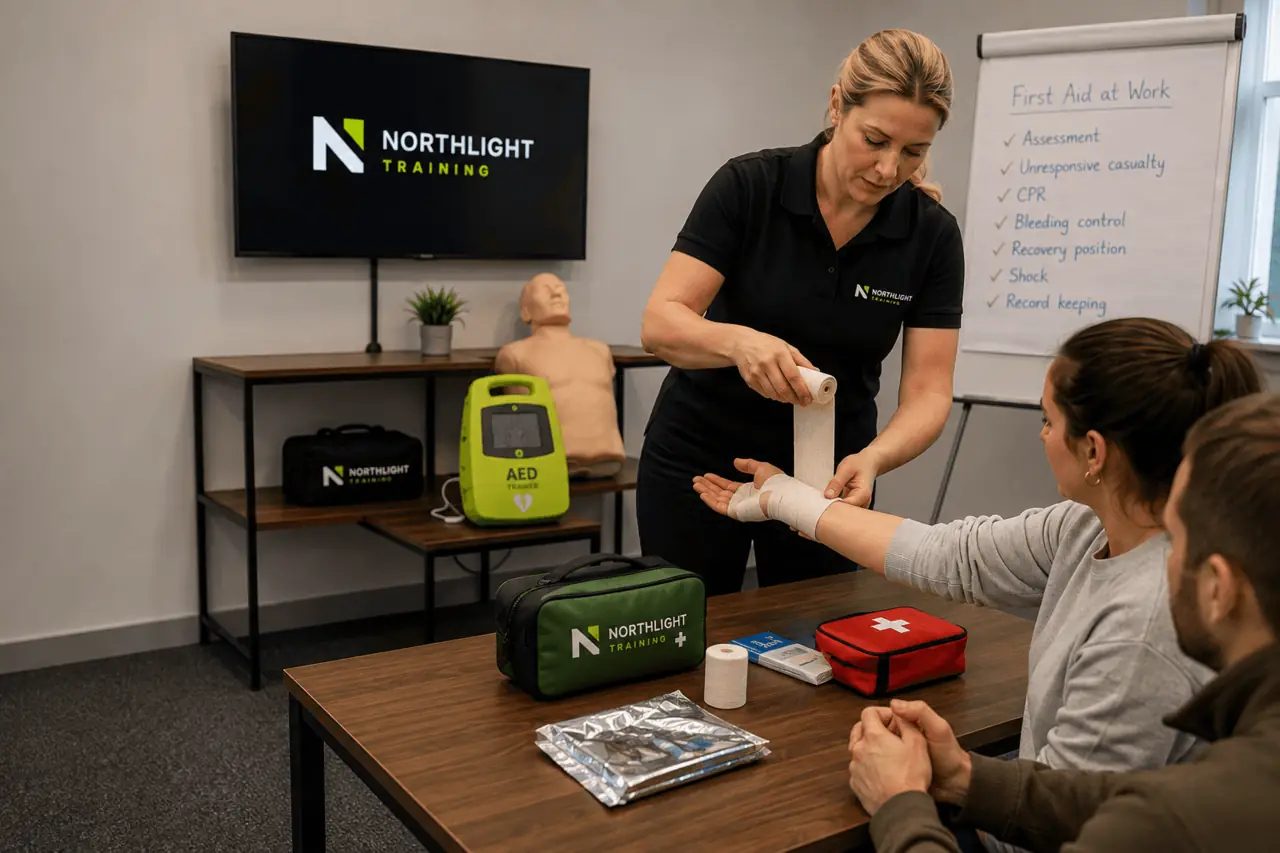
Training is one part of the arrangement. Telling people about it, and reviewing it, are the others.
If repeated gaps appear, revisit the provision rather than continuing to work around them.
THE NORTHLIGHT TAKEAWAY
How many people should you train?
01
Establish the provision
What does your needs assessment say needs to be available?
For some workplaces, that may be an appointed person.
02
Use the guidance
How many trained first-aiders should be available?
HSE’s staffing levels, alongside your actual hazards and circumstances.
03
Test the real rota
How many people need training to keep that provision?
Shifts, locations, hybrid working and normal absences.
04
Check the training
Are they trained for what they may need to manage?
Headcount and competence are separate decisions.
KEEP READING
What training do those people need?
Once you know how many people may need training, the next question is what they should be trained to do. Our job isn’t to sell you the longest course or the most places. It’s to help you choose provision that fits the needs you’ve identified.

TRAINING FOR THIS TOPIC
Courses that cover this
Regulated qualifications. Public dates in Belfast, Mallusk and Ballymena, or at your workplace.
SOURCES AND FURTHER READING
Health and Safety (First-Aid) Regulations (Northern Ireland) 1982, regulations 3 to 4, read with the Health and Safety (First-Aid) (Amendment) Regulations (Northern Ireland) 2017, regulation 2.
HSENI: First aid at work. Northern Ireland requirements and use of HSE guidance.
HSENI: First aid. Appointed-person responsibilities, absence cover and reviewing arrangements.
HSE: First aid at work: your questions answered (INDG214), including Tables 1 and 2.
HSE: Are you an employer? Assessing first-aid needs, including mental health and recording decisions.
Reviewed
10 Oct 2026
Next review by
10 Oct 2027
Written by
Northlight Training
Reviewed sooner if Northern Ireland legislation, HSENI or HSE guidance, our course information or the calculator changes.