Home › Advice & tools › Guides
GUIDE · WORKPLACES
Reviewed 11 Oct 2026 · Next review Oct 2027 · Northlight Training
THE SHORT ANSWER
Start with what could happen. Then work out the help and arrangements it needs.
Look at the work people actually do, what could reasonably happen, who is working and when, where they work and how quickly help can reach them.
Don’t start with a course name or a number of first-aiders. Those decisions come after the assessment, not before it.
THE METHOD
Situation, response, provision
Start with one practical question: if somebody is injured or becomes ill while working here, what help might they reasonably need, and what arrangements need to be in place to provide it? Then work through three questions, in this order.
1
Situation
What could reasonably happen?
Look at the work, the people and the workplace.
2
Response
What immediate first-aid help might be needed?
Turn hazards and circumstances into realistic situations somebody may have to respond to.
3
Provision
What people, competence, equipment and arrangements need to be available?
Only now decide the provision that makes that response possible.
Northern Ireland law requires employers to provide adequate and appropriate first-aid equipment, facilities and personnel. A first-aid needs assessment is how you work out what that means for your workplace. We recommend keeping a proportionate record of what you considered, what you decided and any actions you identified.
TWO ASSESSMENTS, TWO QUESTIONS
First-aid needs assessment or risk assessment?
They work together, but they answer different questions.
RISK ASSESSMENT
How do we stop people being harmed?
Identifies hazards, who might be harmed and the measures needed to prevent or control those risks.
THE SAW EXAMPLE
A workshop uses a powered saw: the risk assessment concentrates on preventing somebody from coming into contact with it.
FIRST-AID NEEDS ASSESSMENT
If somebody is still hurt, what help needs to be there?
Asks what first-aid arrangements need to be available if somebody is injured or becomes ill despite those controls.
THE SAW EXAMPLE
For the same saw: a serious cut or life-threatening bleeding, the immediate response that could be needed and the arrangements required to provide it.
First aid does not replace effective risk control. It prepares you for the situation where somebody still needs help.
OUR WORKED EXAMPLE
Suppose you run a furniture business
We’ll use one workplace throughout this guide: a furniture business employing 45 people. We’ve completed a full needs assessment for it using our free template, and at the end of each step you’ll see what we recorded and why.
28
production, with woodworking machinery and powered tools
5
warehouse and despatch, with vehicles and manual handling
Production starts before the office opens
Some office staff work from home
The warehouse is a separate building
Customers and suppliers occasionally visit
Writing “45 employees, furniture company” tells us very little about its first-aid needs. The useful information is in what those people actually do, where they do it and when they are there.
Today, the business has two First Aid at Work first-aiders, both in the office from 9am to 5pm. It has one first aid kit, kept in reception, and no defibrillator. On paper, that can look like enough.
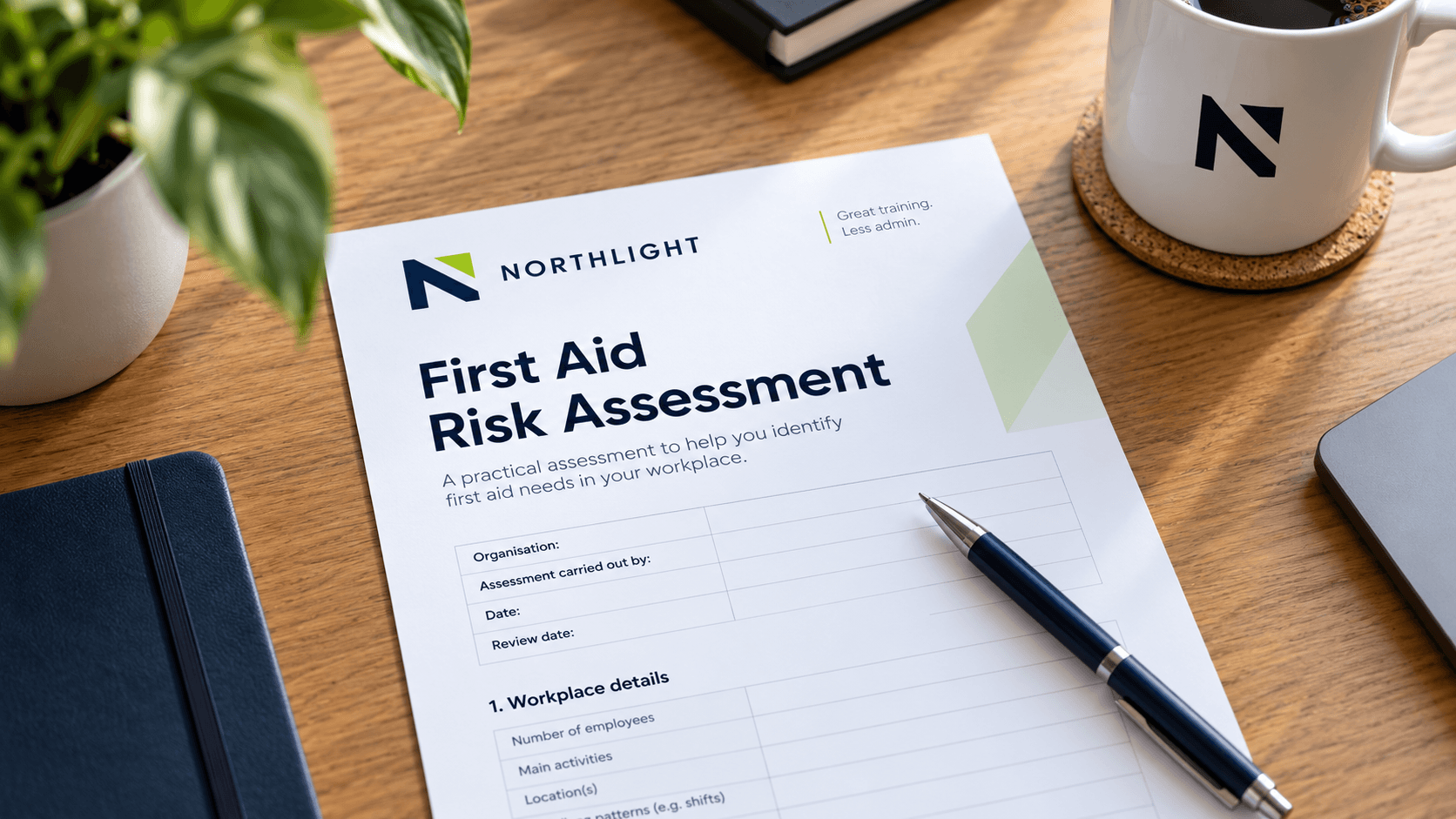
You can follow along with the completed example, or open the blank template and work through your own workplace as you read.
1
STEP 1
Define the workplace you’re assessing
First, be clear about what the assessment actually covers. Consider:
The workplace or site
The activities taking place
Usual and maximum employee numbers
Working days and hours
Shifts, early starts and out-of-hours working
Home, remote, lone or travelling workers
Separate buildings, floors or work areas
Shared premises where relevant
IN OUR WORKED EXAMPLE
Treating all 45 employees as one group would hide important differences. The office, production area and warehouse involve different activities, aren’t necessarily occupied at the same times, and the warehouse is physically separate. That matters when we decide what arrangements need to work across the site.
We split the site into four areas: the office and design studio, the production workshop, the warehouse at the far end of the yard, and the company van, which two warehouse staff use for deliveries three days a week.
We recorded each area’s hours separately, because production starts at 7am, the warehouse at 8am and the office at 9am. We also noted that four office staff, including one of the two first-aiders, work from home on Fridays. That detail turns out to matter in Step 6.
2
STEP 2
Turn workplace hazards into first-aid situations
Your existing workplace risk assessments are one of the best places to start. But don’t simply copy a list of hazards. Translate them into situations somebody might actually need to respond to.
Tap an area of the site to turn its work into first-aid situations.
Machinery-related injuries and potentially serious bleeding, from 7am.
Powered saws and cutting equipment
Serious cuts or potentially life-threatening bleeding
Immediate bleeding control, emergency help and appropriate equipment
Moving and handling timber or finished products
Sprains, strains or injuries involving bones and joints
Assessment and appropriate first-aid management
Substances used in production
Exposure, splash or burns depending on the substance
Response based on the actual substance and its safety information
INSTEAD OF
“We have machinery.”
WE CAN SAY
“This machinery creates a reasonably foreseeable first-aid situation, and this is the response we may need to provide.”

In our example, production uses woodworking machinery and powered tools.
What about previous accidents?
Use accident records, previous first-aid incidents and relevant near misses as evidence, but don’t make them your only test. A serious injury does not have to have happened before for it to be reasonably foreseeable.
Several accident-free years do not make the potential consequences of dangerous machinery irrelevant. Equally, one unusual incident does not automatically mean your entire first-aid provision needs to change.
IN OUR WORKED EXAMPLE
We added two situations the table above doesn’t show: dust or fragments in the eye at the machines, and cardiac arrest, which could happen to anyone, anywhere onsite.
Then we checked three years of accident records. Most entries were minor cuts in production. One stood out: a deep hand cut at a bandsaw at 7.40am, when nobody trained was onsite and the only kit was locked in reception. It wasn’t life-threatening, but it showed exactly when the arrangements didn’t work.
At this point, we still couldn’t say how many first-aiders the business needs or what training they should have. Those decisions come after the assessment, not before it.
3
STEP 3
Consider the people who may need help
The work itself is only part of the picture. Consider whether anything about the people doing it changes the first-aid response you may need.
Employee numbers
Young or inexperienced workers
Trainees
Pregnant workers
Employees with a disability
Relevant known health needs
People working alone, remotely or away from the main workplace
Identify the need, not the medical history
This isn’t about collecting everyone’s medical history. It’s about identifying relevant first-aid needs. The same applies to other workforce considerations, including mental health where relevant: identify the need, consider an appropriate response and avoid starting with a training product and working backwards to justify it.
SUPPOSE THE BUSINESS KNOWS ABOUT A SEVERE ALLERGY
“Our first-aid provision needs to include an appropriate response to suspected anaphylaxis.”
That’s the useful conclusion. The assessment doesn’t need to become an unnecessary record of an identifiable employee’s medical information.
IN OUR WORKED EXAMPLE
We recorded the need, not the person: “Provision must include a response to suspected anaphylaxis in every area, whenever people work.”
We also noted an apprentice in production, agency workers at busy times and occasional work experience placements in the design studio. None of them needed separate provision, as long as induction shows them who the first-aiders are on their first day.
4
STEP 4
Check where and when people work
A first-aid arrangement can look perfectly adequate until you ask whether it works at 7am.
Working from 7am
Open from 9am
Gap
Covered
The hazard hasn’t changed. The potential injury hasn’t changed. The availability of the response has.
Now consider the warehouse at the far end of the site
It isn’t enough to say “We have a first-aid kit and a first-aider.” Ask whether they are available where and when somebody might actually need them.
Can a trained person reach the warehouse promptly?
Can employees get to appropriate equipment?
How will somebody summon help?
Can an ambulance reach the casualty, and does somebody know where to direct it?
DON’T FORGET EMERGENCY ACCESS
Calling 999 or 112 is only part of the emergency arrangement.
Do people know the correct address and entrance? Could gates or access controls delay emergency services? Does somebody need to meet an ambulance? Could a remote work area or unreliable mobile reception delay help?
Apply the same thinking to shifts, nights and weekends, separate floors or buildings, lone and travelling workers and remote locations. For our furniture business, the assessment now needs to account for first-aid provision being available from 7am and across separate parts of the site.
IN OUR WORKED EXAMPLE
We wrote down what happens now, area by area and hour by hour. From 7am to 9am, and on overtime Saturdays, production had nobody trained onsite and no kit it could reach. The warehouse had no kit at all, and mobile signal is weak at the back of the building.
We also recorded the address and entrance to give 999. The front door stays locked until 9am, so an ambulance needs the yard gate, and nobody had agreed who would meet it.
5
STEP 5
Decide what provision you need
You should now have a clearer picture of what could reasonably happen, the immediate response that might be needed, who may need help, where incidents could occur and when the arrangements need to work. Now turn that evidence into provision, using the same model.
SUPPOSE AN EMPLOYEE SUFFERS A SEVERE CUT ON PRODUCTION MACHINERY
1
Situation
A potentially life-threatening bleed occurs in the production area.
2
Response
Somebody needs to recognise how severe the bleeding is, give appropriate immediate first aid, summon emergency help and manage the situation until further help arrives.
3
Provision
Appropriate competence available while the work is taking place, suitable equipment that can be reached quickly and an emergency arrangement that gets professional help to the casualty.
The provision you identify may involve trained people, first-aid equipment, facilities, emergency arrangements or additional measures a particular workplace needs. Each decision should respond to an identified need.

Provision is more than trained people: equipment, facilities and emergency arrangements count too.
Two decisions follow
Those decisions follow from the assessment. They shouldn’t replace it.
IN OUR WORKED EXAMPLE
Each decision answers a situation from Step 2.
A life-threatening bleed at the machines is foreseeable. So production first-aiders need training in tourniquets and haemostatic dressings, and a critical injury pack goes with each production kit.
Fractures, eye injuries and anaphylaxis are all possible. So we chose First Aid at Work rather than Emergency First Aid at Work.
One first-aider needs to be in production at any time, but we decided to train three, so leave, sickness and overtime Saturdays are covered.
The defibrillator goes inside the production yard door, because we timed the walk from the far corner of the warehouse at 1 minute 50 seconds.
We recorded what we decided against, too. There’s no burns kit, because burns are limited to small glue burns near running water. Instead, there are extra burns dressings in the kit by the edge bander.
6
STEP 6
Test it against a real working week
Don’t stop when the arrangement looks sensible on paper. Suppose the furniture business decides trained first-aid cover needs to be available whenever production is operating. Then test it.
Look at Tuesday at 7am. Is the cover there?
What happens when somebody is on annual leave?
What about the separate warehouse?
What happens when somebody you rely on is working from home or away?
The question isn’t “Do we employ trained first-aiders?” It’s “Is the provision our assessment says we need actually available where and when we need it?”
NORTHLIGHT TIP
Test a real week, not an ideal one
Take an actual working week and map your required provision against it. Then repeat the exercise with one of the people you normally rely on taking annual leave. If a shift, working period or part of the workplace loses the provision your assessment says should be available, you’ve found a practical gap to address.
IN OUR WORKED EXAMPLE
We tested a real week. Production had no first-aider before 9am on any day, and after 9am it relied on the office.
Then we repeated the week with Jo, one of the office first-aiders, on annual leave. On the Friday, nobody trained was onsite at all, because the other first-aider works from home on Fridays. Nothing on paper had shown that.
7
STEP 7
Record it and keep it current
At the end of the assessment, you should be able to summarise three things.
Provision required
What people, competence, equipment, facilities and emergency arrangements should be available?
Provision currently available
What do you already have?
Gaps and actions
What needs to change? Perhaps training another person, updating training, moving or adding equipment, better emergency-access information or specialist advice.
It might also mean nothing needs to change. An assessment doesn’t have to end in a training booking or something to buy. If your arrangements meet the needs you’ve identified, record that conclusion and why.
IN OUR WORKED EXAMPLE
The assessment ends with a list of actions, each with an owner and a date:
Train three production employees and one warehouse employee.
Add the bleeding training and critical injury packs.
Put kits where people work.
Fit a defibrillator inside the production yard door.
Agree who meets the ambulance.
Some things didn’t need to change, and we said so. The office first-aiders and the reception kit already met the office’s needs.
The first review date is the date by which the actions should be finished, when we’ll test the week again. After that, the business reviews the assessment once a year, or sooner if something changes.
Do you need to write it down?
First-aid guidance doesn’t require a separate formal document simply because it’s called a “first-aid needs assessment”. That’s different from the wider legal requirements for workplace risk assessments.
Our recommendation: keep a proportionate record of what you considered, what you decided and why. A straightforward workplace may need only a brief record; one with different hazards, shifts or locations will need more.
When should you review it?
There isn’t a fixed annual legal interval. Review your needs periodically and when something material changes:
New machinery, substances or activities
Changes to shifts or staffing
New premises or layout
Different lone or remote working
A first-aider leaving
An incident that exposes a gap
CUSTOMERS, VISITORS AND THE PUBLIC
What about people who aren’t employees?
The workplace first-aid legislation focuses on employees, but HSE guidance recommends considering non-employees when assessing first-aid needs. If customers, visitors, pupils, service users or other people regularly use your premises, consider whether their presence changes the arrangements it would be sensible to make.
Don’t
simply add visitor numbers to your employee headcount and apply a staffing ratio.
Do
compare like with like: a closed office with an occasional visitor and a venue welcoming hundreds of people a day may reasonably reach different conclusions. Other legal, contractual or sector requirements may also apply.
Workplace first aid needs assessment
Work through the seven steps in this guide and record what you decide: the situations that could happen, the people involved, when and where they work, the provision you need, what you have now, and the gaps and actions. It includes a register of your first-aiders. Free to download: Word to edit, PDF to print. No sign-up needed.
Use the First Aid Requirements Calculator
It helps you consider some of the factors that may influence your first-aid provision and gives an initial indication of what may be appropriate. It can’t assess your actual workplace, so it doesn’t replace a needs assessment. Use it as a starting point.
THE NORTHLIGHT TAKEAWAY
Situation, response, provision
01
Situation
What could reasonably happen?
Look at the work being undertaken, the people involved and the workplace in which it happens.
02
Response
What immediate first-aid help might be needed?
Turn hazards and circumstances into realistic situations somebody may have to respond to.
03
Provision
What needs to be available?
Test it against the real workplace, including shifts, locations and absences. Record your decision and review it when things change.
KEEP READING
Two decisions follow from your assessment

TRAINING FOR THIS TOPIC
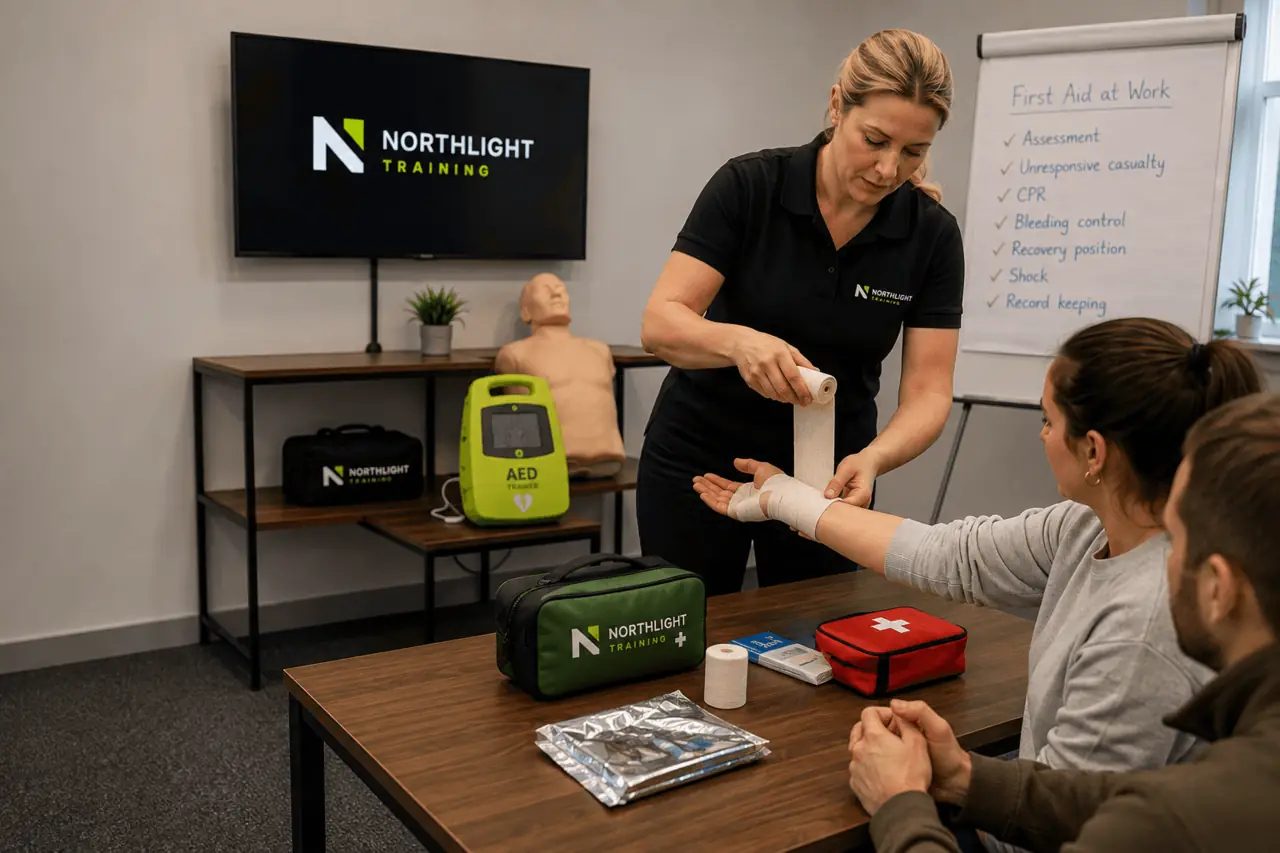
Courses that cover this
Regulated qualifications. Public dates in Belfast, Mallusk and Ballymena, or at your workplace.
SOURCES AND FURTHER READING
Health and Safety (First-Aid) Regulations (Northern Ireland) 1982, regulations 3 to 4, read with the Health and Safety (First-Aid) (Amendment) Regulations (Northern Ireland) 2017, regulation 2.
Management of Health and Safety at Work Regulations (Northern Ireland) 2000, particularly regulation 3, for the separate general workplace risk-assessment duties.
HSENI: First aid at work. Northern Ireland first-aid requirements and use of HSE guidance.
HSENI: First aid. Guidance on assessing needs, appointed persons, equipment and first-aid arrangements.
HSE: First aid at work: Guidance on Regulations (L74), third edition, amended in 2024. Particularly the guidance on assessing first-aid needs, workplace factors, equipment, coverage and review.
HSE: Are you an employer? Guidance on assessing first-aid needs and making appropriate provision.
ICO: Guidance on workers’ health information, relevant where identifiable employee health information is handled.
Reviewed
11 Oct 2026
Next review by
11 Oct 2027
Written by
Northlight Training