Home › Advice & tools › Guides
GUIDE · TRAINING CHOICE
Reviewed 10 Oct 2026 · Next review Oct 2027 · Northlight Training
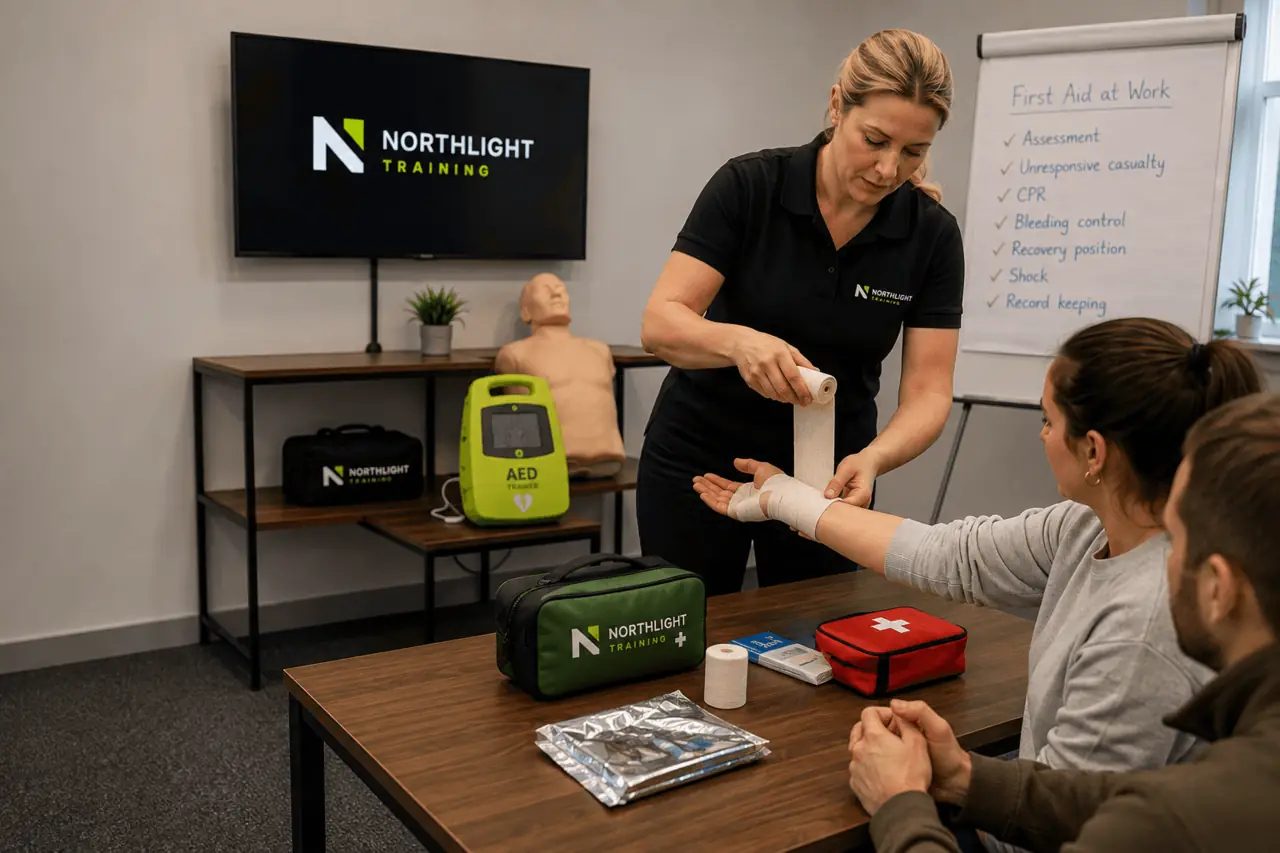
THE SHORT ANSWER
Choose the course that matches what your first-aiders may need to deal with.
The aim isn’t to choose the longest course. It’s to choose training that matches the need.
THE TWO WORKPLACE COURSES
One foundation. One that goes further.
1 DAY · STA LEVEL 3
Emergency First Aid at Work (EFAW)
The emergency first-aid foundation.
Assessing an incident, an unresponsive casualty, CPR and a defibrillator, choking, seizures, shock, external bleeding and minor injuries.
3 DAYS · STA LEVEL 3
First Aid at Work (FAW)
The same foundation, plus a wider range.
Adds fractures and sprains, head and spinal injuries, eye and chest injuries, wider burns and poisoning, illnesses such as heart attack, stroke, asthma and anaphylaxis, and fuller casualty assessment.
Both lead to Level 3 qualifications awarded by Safety Training Awards (STA), a regulated awarding body. EFAW shouldn’t be thought of as a lesser form of first-aid training simply because the course is shorter.
1
THE SHARED FOUNDATION
What do both courses cover?
Both qualifications share the unit Emergency First Aid in the Workplace. That provides the emergency foundation:

Both courses include CPR and using an automated external defibrillator (AED).
Assessing an incident and getting help
Caring for an unresponsive casualty
CPR
Using an automated external defibrillator (AED)
Choking
Seizures
Shock
External bleeding
Minor injuries, including minor burns and scalds
These are significant, potentially life-saving skills. If EFAW’s content matches the needs you’ve identified, it may be exactly the right qualification.
2
WHAT FAW ADDS
What does FAW add?
FAW adds the unit Recognition and Management of Illness and Injury in the Workplace. It extends the emergency foundation into a wider range of injuries, illnesses and assessment skills.
3 days
FAW: the same foundation, plus a wider range
7
groups of extra content in FAW, listed below
Suspected fractures, dislocations, sprains, strains and cramp; applying support and elevated slings
Relevant where falls, impacts, manual work or physical activity could result in these injuries
Suspected head and spinal injuries, including a practical spinal-injury competency
Particularly relevant where significant falls, impacts or vehicle-related injuries are foreseeable
Eye injuries and chest injuries
May be relevant where there is a risk from fragments, splashes or significant impacts
Wider burns and scalds management, including heat, chemicals and electricity; suspected poisoning
Relevant where work involves hot equipment, electricity, chemicals or hazardous substances
Heart attack, stroke, asthma attack and hypoglycaemic emergency
Shows why physically lower-hazard workplaces can still identify a need for broader training
Anaphylaxis, including demonstrating an adrenaline auto-injector training device
Relevant where the assessment identifies a need to prepare for severe allergic reactions
Gathering a casualty history and demonstrating a head-to-toe check
Adds further casualty-assessment skills alongside the initial emergency assessment shared by both courses
Source: STA qualification specifications v26.1: EFAW unit specification, page 9; FAW unit specifications, pages 9–10. HSE L74, Appendices 5–6, provides broader course-content guidance.
Don’t treat this as a checklist where one relevant item automatically means you need FAW. Compare the additional content with the situations in your needs assessment.
TRY IT
Match the course to the situation
Start with what your first-aiders may need to deal with, then see which training prepares them for it.
Tap the situations your needs assessment says your first-aiders may need to deal with.
Pick a situation to see which training covers it.
This compares course content with situations. One item doesn't automatically mean FAW, and it doesn't replace your needs assessment.
3
IN PRACTICE
Three workplaces, three different decisions
These examples show how Northlight would apply that approach. They are professional judgements about the circumstances described, not fixed legal classifications.
WORKPLACE 1
A straightforward administrative office
The employer has identified a need for a trained first-aider. People mainly work at desks, use computers and attend meetings. The assessment hasn’t identified unusual equipment, hazardous activities or a particular health need requiring additional training.
EFAW prepares the first-aider for emergencies that can still happen in an office: somebody becoming unresponsive, choking, having a seizure or suffering significant external bleeding.
WE WOULD NORMALLY RECOMMEND
EFAW. We wouldn’t recommend FAW simply because it is the longer qualification.
WORKPLACE 2: THE SAME OFFICE, ONE CHANGE
The assessment now identifies a need to respond to anaphylaxis.
Unchanged
The industry
Unchanged
The desks
Unchanged
The number of employees
Changed
The training need
Anaphylaxis goes beyond the standard EFAW unit. FAW includes recognising suspected anaphylaxis, identifying the appropriate first-aid response and demonstrating the use of an adrenaline auto-injector training device.
That doesn’t automatically mean everybody must complete FAW. FAW may be right for some first-aiders, or EFAW with suitable additional training may address the need. What matters is that EFAW alone no longer covers everything the employer has decided its provision needs to address.
This is why workplace labels can only take you so far.
WORKPLACE 3
A vehicle-repair workshop
Lifting vehicles
Powered tools
Hot components
Substances that could splash
The assessment may reasonably identify injuries involving bones and joints, burns, eyes, the head or spine among the situations first-aiders could need to manage. FAW’s additional content has a clear relationship to those foreseeable situations.
WE WOULD NORMALLY RECOMMEND
FAW.
BUT FAW ISN’T THE END
If the workshop also fabricates stainless-steel components using pickling paste containing hydrofluoric acid, HSE recommends specific additional training and first-aid arrangements. General chemical-burn content within FAW does not by itself establish competence for that response.
Identify the situation first. Then make sure the training actually prepares people for it.
A SIGNIFICANT RISK
What if catastrophic bleeding is a significant risk?
Both EFAW and FAW include recognition and management of life-threatening external bleeding. Northlight includes tourniquet training in both courses.
But a competency appearing in a qualification doesn’t automatically tell you whether the amount and context of training are enough for a particularly significant workplace risk, such as machinery capable of causing severe injuries or traumatic amputation.
WE WOULD STILL ASK
“Does the training our people receive adequately prepare them for the serious injuries we can reasonably foresee here?”
If catastrophic bleeding is a significant identified risk, additional practical training may be appropriate: more time to practise realistic scenarios, with the equipment actually provided, around the workplace’s own machinery and environment. It builds on EFAW or FAW rather than replacing them.
SOMETIMES THE ANSWER IS DIFFERENT
A childcare setting
EFAW and FAW are workplace first-aid qualifications. They aren’t designed to provide every type of first-aid competence every organisation might need.
Where the identified need relates to babies and children, appropriate paediatric first-aid training may be required rather than simply choosing the longer FAW qualification.

Where the need relates to babies and children, paediatric first-aid training may be required.
Several possible outcomes
1
EFAW meets the identified training need
2
FAW is appropriate because its additional competencies are relevant
3
EFAW or FAW needs additional training for a specific need
4
A different type of first-aid training is more appropriate
NORTHLIGHT TIP
Start with the situation, not the course
Instead of asking “Do we need EFAW or FAW?”, try:
“Our first-aiders may need to deal with this injury, illness or emergency. Which parts of the training prepare them for it, and is anything else required?”
DON’T LET THE WORKPLACE LABEL DECIDE
Describe the work, not just the industry
A workplace described as “higher risk” doesn’t automatically require FAW in every circumstance. Likewise, an office doesn’t automatically mean EFAW.
Engineering company A
Employees carry out fabrication, welding and production activities.
Engineering company B
Mainly designers and project staff working in an office, with fabrication outsourced.
Their industry description is similar. Their first-aid needs may not be.
NORTHLIGHT TIP
If you’re asking a training provider for advice, don’t stop at “We’re an engineering company” or “We’re an office”. Explain what people actually do and the injuries, illnesses or situations your assessment says first-aiders may need to manage.
DO YOU NEED A TRAINED FIRST-AIDER AT ALL?
Not necessarily. And if you do, it’s two decisions.
Depending on your needs assessment, an appointed person (someone who takes charge of the first-aid arrangements) may provide adequate and appropriate arrangements without an EFAW or FAW qualification. If trained first-aiders are required, keep two decisions separate:
DECISION 1
What should they be trained to do?
That’s the question this guide answers.
DECISION 2
How many people need training so the cover stays available?
Read How many first aiders do I need in my workplace?
WHAT THE LAW SAYS
What Northern Ireland law requires
The Health and Safety (First-Aid) Regulations (Northern Ireland) 1982, as amended
Employers must provide adequate and appropriate first-aid equipment, facilities and personnel, and must inform employees about the arrangements made.
The legislation doesn’t say every office should choose EFAW, every workshop should choose FAW, or that a particular number of employees decides the qualification. HSENI uses HSE guidance to support Northern Ireland employers in assessing appropriate provision and training. Use it as part of your assessment, not as an automatic workplace classification.
Work through your first-aid requirements
Northlight’s First Aid Requirements Calculator works through your workplace, workforce and some of the factors affecting first-aid provision, and gives an initial indication of the training that may be appropriate. Use the result to support your needs assessment, not as a substitute for it.
THE NORTHLIGHT TAKEAWAY
Before you choose a course
01
Identify the situations
What might your first-aiders reasonably need to deal with?
Start with the injuries, illnesses and emergencies your needs assessment identified.
02
Match the course content
Does EFAW provide what you need, or is FAW’s extra content relevant?
Choose for the content, not the length or the label on your industry.
03
Identify any gaps
Is there a need the standard course doesn’t fully cover?
Add specialist or extra training rather than assuming FAW covers everything.
04
Check the wider provision
Will trained people actually be available when needed?
Training choice and staffing are separate decisions.
KEEP READING
Keep working through your provision

TRAINING FOR THIS TOPIC
Courses that cover this
Regulated qualifications. Public dates in Belfast, Mallusk and Ballymena, or at your workplace.
SOURCES AND FURTHER READING
Safety Training Awards: STA Level 3 Award in Emergency First Aid at Work, qualification specification v26.1, 2026. Especially the unit specification on page 9.
Safety Training Awards: STA Level 3 Award in First Aid at Work, qualification specification v26.1, 2026. Especially the unit specifications on pages 9–10.
Health and Safety (First-Aid) Regulations (Northern Ireland) 1982, regulations 3 to 4, read with the Health and Safety (First-Aid) (Amendment) Regulations (Northern Ireland) 2017, regulation 2.
HSENI: First aid at work and First aid. Northern Ireland guidance on first-aid duties, training choices and appointed-person arrangements.
HSE: First aid at work: Guidance on Regulations (L74), third edition, amended in 2024. Particularly the guidance on first-aid needs assessments and Appendices 4–6.
HSE: Selecting a first-aid training provider: A guide for employers (GEIS3).
HSE: Post weld cleaning using pickling pastes. Specialist guidance relevant to the hydrofluoric-acid example.
Reviewed
10 Oct 2026
Next review by
10 Oct 2027
Written by
Northlight Training