Home › Advice & tools ›
Training Advice
Guide · Clubs
Most clubs rely on a few willing volunteers when someone gets hurt at training or on match day. This article explains what Northern Ireland law actually requires of a sports club, what governing bodies expect, and what we’d have in place before every session.

THE SHORT ANSWER
Workplace first aid law in Northern Ireland applies to employers and their employees. If your club is run entirely by volunteers, the Health and Safety (First-Aid) Regulations (Northern Ireland) 1982 don’t require it to have a first-aider. If it employs anyone, such as a groundskeeper or bar staff, it has a legal duty to provide first aid for them.
That’s rarely the end of it. Government safeguarding guidance expects clubs to have first aid arrangements and, ideally, a qualified first-aider. Some governing bodies, including the IRFU and the GAA, recommend trained people and a defibrillator at training and matches, and Irish FA licensing for the NIFL Championship and Women’s Premiership requires a trained first-aider at home matches.
Our advice is to have someone trained in first aid with each pitch or training area in use, a defibrillator that can be reached quickly, and an agreed procedure for a suspected concussion.
Does workplace first aid law apply to your club?
The Health and Safety (First-Aid) Regulations (Northern Ireland) 1982 place the duty on an employer to provide adequate and appropriate first aid for its employees. They say nothing about volunteers, members, players or spectators. So a club staffed entirely by volunteers has no duty under these Regulations. NI Business Info points the same way: it says organisations staffed entirely by volunteers aren’t required to carry out a risk assessment.
That changes as soon as the club employs someone. A groundskeeper, bar staff or an administrator on the payroll makes the club an employer, and it then needs a first aid needs assessment for those employees. For a handful of staff, an appointed person and a stocked kit may be enough. Whether a paid coach counts as an employee depends on their contract, so check that separately.
Players and spectators aren’t employees, so they don’t count towards the staffing numbers in HSE’s guidance. That guidance, which the Health and Safety Executive for Northern Ireland (HSENI) follows, still strongly recommends including people who aren’t employees when you plan first aid. It also suggests checking that your liability insurance covers what your first-aiders do.
What your sport expects
The workplace rules set a low bar for most clubs. Governing bodies, leagues and safeguarding standards are where the real expectations sit, and they vary by sport and level.
| Sport or body | What we found | Requirement or recommendation |
|---|---|---|
| Football (Irish FA) | NIFL Championship and Women’s Premiership licensing requires a trained first-aider at home matches, with a current certificate from “an accredited provider”, plus a first aid kit and stretcher. We haven’t found a first-aider rule for grassroots football. | Requirement at those levels |
| Rugby (IRFU) | The IRFU says trained people should be present at all club and school rugby activities, and strongly advocates a working defibrillator pitchside at every game and training session. Its concussion guide tells coaches to attend a SAFE Rugby course. | Recommendation |
| Gaelic games (GAA) | The GAA aims to increase the number of qualified first-aiders at all training sessions and matches, and runs its own first aid course for members. Ulster GAA’s defibrillator guidance covers training members to use one. | Recommendation |
| Hockey and cricket | We haven’t found a governing body rule requiring a first-aider at training or matches. | Check with your branch or league |
| All sports (Department for Communities and Sport NI) | Safeguarding guidance expects a first aid box, a named first aid person, an injury and accident procedure, medical information and emergency contacts for young players, and parents’ consent before any medication is given. | Safeguarding expectation |
- Sport or body
- Football (Irish FA)
- What we found
- NIFL Championship and Women’s Premiership licensing requires a trained first-aider at home matches, with a current certificate from “an accredited provider”, plus a first aid kit and stretcher. We haven’t found a first-aider rule for grassroots football.
- Requirement or recommendation
- Requirement at those levels
- Sport or body
- Rugby (IRFU)
- What we found
- The IRFU says trained people should be present at all club and school rugby activities, and strongly advocates a working defibrillator pitchside at every game and training session. Its concussion guide tells coaches to attend a SAFE Rugby course.
- Requirement or recommendation
- Recommendation
- Sport or body
- Gaelic games (GAA)
- What we found
- The GAA aims to increase the number of qualified first-aiders at all training sessions and matches, and runs its own first aid course for members. Ulster GAA’s defibrillator guidance covers training members to use one.
- Requirement or recommendation
- Recommendation
- Sport or body
- Hockey and cricket
- What we found
- We haven’t found a governing body rule requiring a first-aider at training or matches.
- Requirement or recommendation
- Check with your branch or league
- Sport or body
- All sports (Department for Communities and Sport NI)
- What we found
- Safeguarding guidance expects a first aid box, a named first aid person, an injury and accident procedure, medical information and emergency contacts for young players, and parents’ consent before any medication is given.
- Requirement or recommendation
- Safeguarding expectation
“We haven’t found” means exactly that, not that no rule exists. Leagues, branches and county boards can set their own match-day rules, so check yours before the season starts. Treat “should” in a governing body document as a strong expectation, not an optional extra.
How many people, and where?
The deciding question isn’t how many members you have. It’s how many groups are active at the same time, and how quickly help can reach each of them.
Suppose a volunteer-run youth football club has no employees and trains 4 age groups on 2 pitches on Tuesday evenings. There’s no duty under the workplace Regulations, but safeguarding guidance still expects first aid arrangements. One first-aider in the clubhouse can’t be at both pitches when a child goes down. We’d want a trained person with each pitch, a defibrillator everyone knows how to reach within 2 minutes, and a procedure for a suspected concussion that every coach has seen.
Now suppose a senior rugby club employs a groundskeeper and 2 bar staff, and its clubhouse is busy on match days. It has two separate decisions to make. The first is first aid for its 3 employees, which its needs assessment settles. The second is cover for players and spectators at training and matches, where the IRFU’s recommendations and the number of people onsite point to trained people and a defibrillator pitchside. Take away the employees and the first decision disappears, but the second doesn’t.
What to have in place before training and matches
Most of this costs little once it’s set up. Before each session or match, check you have:
A named first-aider for each pitch or training area, someone lined up to cover when they can’t make it, and an agreed person to call 999. Our article on Sport First Aid or EFAW helps you choose their training;
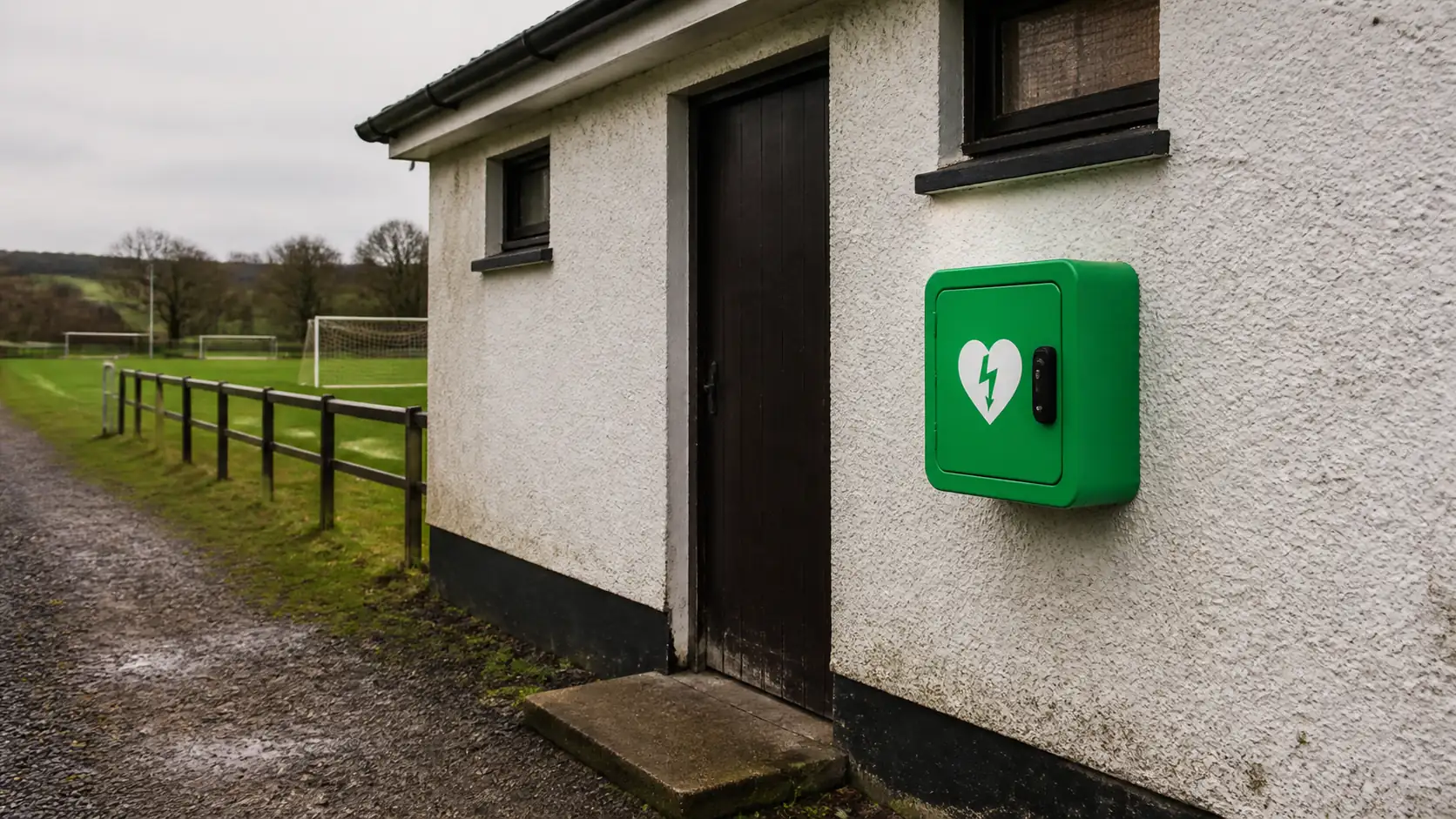
A defibrillator that can be reached quickly, with someone checking it regularly and the device registered on The Circuit, so the ambulance service can direct 999 callers to it. Our article on whether you need a defibrillator explains how to choose and where to put one;
A stocked first aid kit pitchside, not locked in the clubhouse. Our guide to what should be in a first aid kit covers what to include;
A clear route for an ambulance: the postcode and directions to the pitch, the gate open, and a phone with signal;
Medical information and emergency contacts for young players, with parents’ consent before any medication is given;
A way to record injuries, and to report them to your governing body where it asks. In age-grade rugby, the IRFU requires suspected concussions and serious injuries to be reported within 48 hours.
What a first-aider does, and doesn’t do, about a suspected concussion
Every concussion protocol we reviewed gives first-aiders and coaches the same job. The UK grassroots concussion guidelines, which the Department for Communities endorsed for Northern Ireland in 2023, sum it up: if in doubt, sit them out.
A first-aider should:
remove the player straight away if there’s any sign of concussion, and not let them return that day, even if they seem to recover;
make sure they aren’t left alone, and hand them over to a responsible adult;
tell the parents of anyone under 18;
call 999 for any of the red flag signs in your sport’s concussion guidance, or if the player gets worse;
record what happened.
A first-aider shouldn’t diagnose concussion or decide when a player can return. The guidelines say a healthcare professional should assess the player within 24 hours. In Northern Ireland, that usually means a GP or an urgent care centre, or an emergency department for red flag signs. The UK guidance mentions NHS 111, but there’s no NHS 111 service here.
Return to play follows your sport’s own graduated protocol, and medical clearance where it asks for it. The minimum time out differs between sports, so follow your governing body’s, not one you’ve seen elsewhere.
THE NORTHLIGHT TAKEAWAY
Before your next session
01
Check your legal position
Assess first aid for any staff the club employs, and treat safeguarding guidance and your sport’s rules as the standard for everyone else.
02
Read your sport’s rules
Check your governing body, league and competition rules, and treat “should” as a strong expectation.
03
Cover every pitch in use
Have a trained person with each pitch or training area, and a defibrillator that can be reached quickly.
04
Agree a concussion procedure
Remove, hand over, inform and record, and leave return decisions to healthcare professionals.
KEEP READING
Read next

TRAINING FOR THIS TOPIC
Courses that cover this
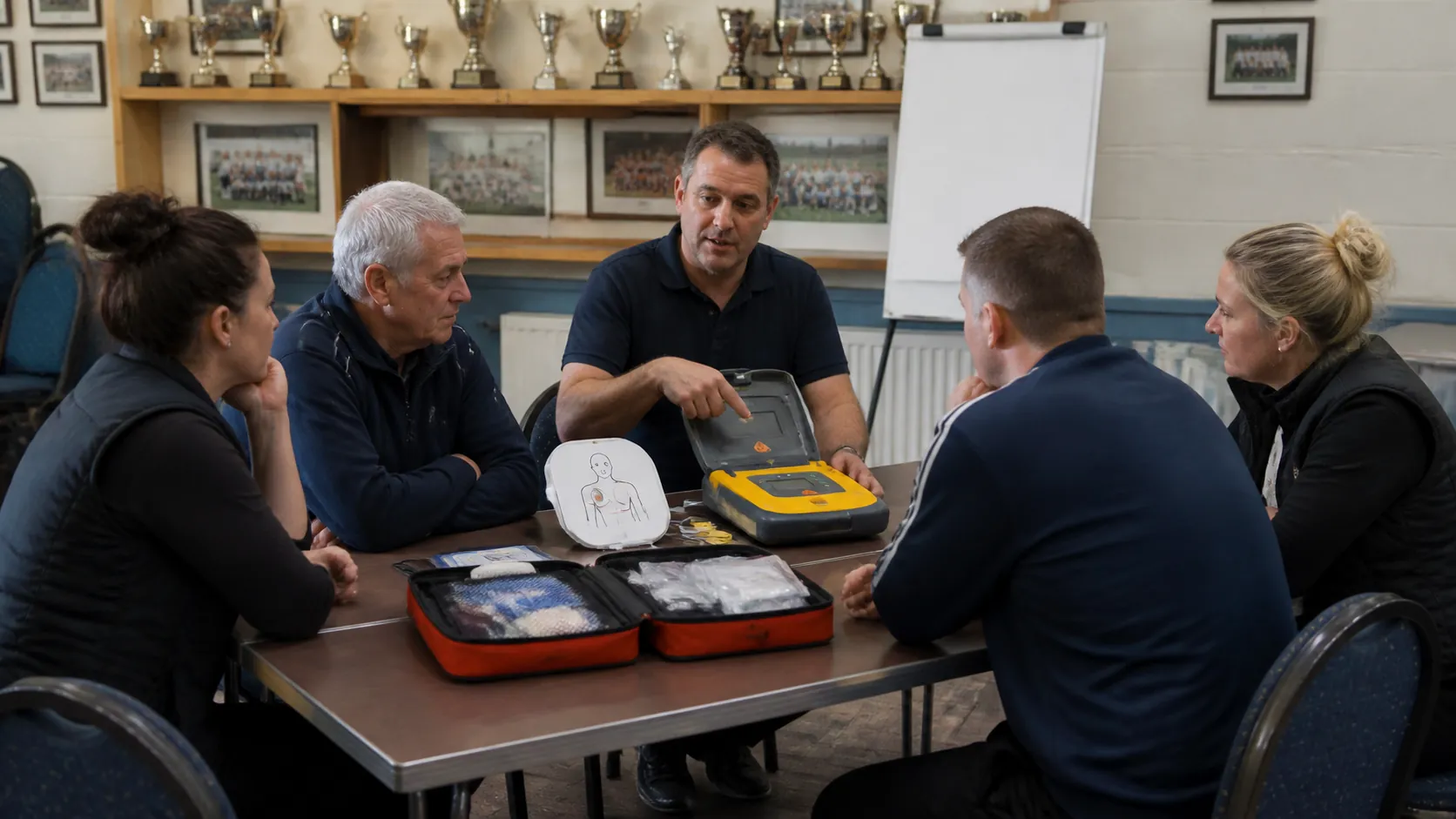
Regulated qualifications. Public dates in Belfast, Mallusk and Ballymena, or at your workplace.
Sources & Further Reading
Northern Ireland legislation: Health and Safety (First-Aid) Regulations (Northern Ireland) 1982, read with the Health and Safety (First-Aid) (Amendment) Regulations (Northern Ireland) 2017. Regulations 3 and 4, the employer’s duty to employees.
HSENI: First aid at work. Minimum provision, first-aiders and HSENI’s adoption of HSE guidance.
HSE: First aid at work: Guidance on Regulations (L74). Paragraphs 28 and 29, people who aren’t employees and insurance.
NI Business Info: Volunteers and health and safety.
Department for Communities: Safeguarding: child safety in sport, and new concussion guidelines for grassroots sport in Northern Ireland (28 Apr 2023).
Sport NI: Club Framework for Safeguarding Standards in Sport, standards 5 and 6.
Sport and Recreation Alliance: If in doubt, sit them out: UK concussion guidelines for non-elite (grassroots) sport, November 2024 update.
Department of Education: Circular 2024/15: Concussion. Northern Ireland routes for medical assessment.
Irish FA: Championship Licence Manual 2026/27, Article 22, and 2025 Women’s Premiership Manual.
IRFU: Guidelines for defibrillators, A guide to concussion in amateur rugby union and Policies for Age Grade Rugby 2026-27.
GAA: First aid and Ulster GAA defibrillator guidelines.
Hockey Ireland: Concussion policy. Cricket Ireland: Concussion management guidelines.
Written by Northlight Training
Review sooner if Northern Ireland legislation or HSENI guidance changes. Check governing body and league documents before each season.