Guides
Work through your workplace activities, people and working arrangements to decide what first-aid provision you actually need.
QUICK ANSWER
How do you carry out a first-aid needs assessment?
Start with a practical question:
If somebody is injured or becomes ill while working here, what help might they reasonably need, and what arrangements do we need to have in place to provide it?
Look at the work people actually do, the injuries and illnesses that could reasonably occur, who is working and when, where they work and how quickly help can reach them.
Then turn that information into decisions about the people, training, equipment, facilities and emergency arrangements you need.
A useful way to think about it is:
Situation → Response → Provision
Situation: What could reasonably happen?
Response: What would somebody need to be able to do?
Provision: What people, training, equipment and arrangements need to be available?
You do not need to start with a course name or a number of first-aiders. Those decisions come from the assessment.
And you do not need a complicated standalone document simply because it is called a "first-aid needs assessment". Northern Ireland law requires adequate and appropriate first-aid provision. Assessing your needs is how you work out what that means for your workplace.
We recommend keeping a proportionate record of the evidence you considered, the decisions you made and any actions you identified. It makes your arrangements easier to explain, maintain and review.
Prefer to work through it as you read?
Northlight's Workplace First Aid Needs Assessment follows the same process as this guide, so you can record your evidence, decisions and actions as you work through each step.
Download the Workplace First Aid Needs Assessment
The assessment form should only be linked here once its final public version and download destination have been approved.
Need an initial indication first?
Our First Aid Requirements Calculator can help you work through some of the factors that influence your provision and give you an initial indication of what may be appropriate.
Use the First Aid Requirements Calculator
It is a starting point, not the completed assessment. It cannot see your machinery, workplace layout, chemical safety information, actual rota or the location of your first-aid equipment. Those are the details that turn general guidance into arrangements that work for your workplace.
First-aid needs assessment or first-aid risk assessment?
You may hear both expressions, but they are not quite the same thing.
Your general workplace risk assessment identifies hazards, who might be harmed and the measures needed to prevent or control those risks.
A first-aid needs assessment uses that information to ask a different question:
If somebody is injured or becomes ill despite those controls, what first-aid arrangements need to be available?
The two exercises therefore work together.
Suppose a workshop risk assessment identifies a powered saw as a hazard. The risk assessment should concentrate on preventing somebody from coming into contact with it.
The first-aid needs assessment does not replace those controls. It asks what the consequences could be if an incident nevertheless occurred and what immediate help might be needed.
First aid is not a substitute for preventing an accident. The assessment is about being prepared if somebody still needs help.
Before deciding what first-aid provision you need, be clear about what the assessment actually covers.
Start with the basics:
Which workplace or site are you assessing?
What activities take place there?
How many employees are usually present?
What is the maximum likely number?
What days and hours do people work?
Are there shifts or out-of-hours working?
Do people work from home, travel or work alone?
Are there separate buildings, floors or work areas?
Do other organisations share the premises?
For a small office, the answer may be straightforward.
For a larger or mixed workplace, treating the entire organisation as one environment can hide important differences.
Suppose you run a furniture business
Imagine a business employing 45 people.
Twelve work in design and administration. Twenty-eight work in production using woodworking machinery and powered tools. Five work in the warehouse and despatch area, where there are vehicle movements and regular manual handling.
Some production employees start before the office opens. Office employees can work from home. Customers and suppliers occasionally visit the premises.
Writing "45 employees, furniture company" tells us very little about its first-aid needs.
The useful information is in what those people actually do, where they do it and when they are there.
We will keep using this business as we work through the assessment.
Your existing workplace risk assessments are one of the best places to start.
But don't simply copy a list of hazards into the first-aid needs assessment.
Translate them into situations somebody might actually need to respond to.
| What happens at work? | What could reasonably happen? | What first-aid help might be needed? |
|---|---|---|
| Powered saws and cutting equipment | Serious cuts or potentially life-threatening bleeding | Immediate bleeding control, emergency help and appropriate equipment |
| Moving and handling timber or finished products | Sprains, strains or injuries involving bones and joints | Assessment and appropriate first-aid management |
| Forklift and vehicle movements | Significant impact, crush, head or other serious injury | Immediate assessment, appropriate first aid and rapid access for emergency services |
| Office and design work | Sudden illness, collapse, choking or a fall | Emergency first-aid response |
| Substances used in production | Exposure, splash or burns depending on the substance | Response based on the actual substance and its safety information |
- What happens at work?
- Powered saws and cutting equipment
- What could reasonably happen?
- Serious cuts or potentially life-threatening bleeding
- What first-aid help might be needed?
- Immediate bleeding control, emergency help and appropriate equipment
- What happens at work?
- Moving and handling timber or finished products
- What could reasonably happen?
- Sprains, strains or injuries involving bones and joints
- What first-aid help might be needed?
- Assessment and appropriate first-aid management
- What happens at work?
- Forklift and vehicle movements
- What could reasonably happen?
- Significant impact, crush, head or other serious injury
- What first-aid help might be needed?
- Immediate assessment, appropriate first aid and rapid access for emergency services
- What happens at work?
- Office and design work
- What could reasonably happen?
- Sudden illness, collapse, choking or a fall
- What first-aid help might be needed?
- Emergency first-aid response
- What happens at work?
- Substances used in production
- What could reasonably happen?
- Exposure, splash or burns depending on the substance
- What first-aid help might be needed?
- Response based on the actual substance and its safety information
This is where the assessment starts becoming useful.
We are no longer saying:
"We have machinery."
We are saying:
"This machinery creates a reasonably foreseeable first-aid situation, and this is the response we may need to provide."
That gives us something against which we can later test training, equipment and emergency arrangements.
Don't use accident history as your only test
Previous incidents are useful evidence.
Look at accident records, previous first-aid incidents and patterns in where and when people have needed help. A near miss may also expose a situation worth considering.
But an incident does not have to have happened before for it to be reasonably foreseeable.
If a machine is capable of causing a serious injury, several accident-free years do not make that potential injury irrelevant.
Equally, one unusual incident does not automatically mean you need to redesign your entire first-aid provision.
Use incident history alongside the work being undertaken and the hazards already identified.
The work itself is only part of the assessment.
You also need to consider the people doing it and whether anything about your workforce changes the first-aid response you may need.
That can include:
the number of employees;
young or inexperienced workers;
trainees;
employees with a disability;
relevant physical or mental-health needs that are known to you;
people working alone, remotely or away from the main workplace.
This does not mean collecting everyone's medical history.
The purpose is to identify relevant first-aid needs, not to create a list of employees' diagnoses.
Back to our furniture business
Suppose the employer knows that an employee has a severe allergy and the first-aid arrangements need to take account of the possibility of anaphylaxis.
That is useful information for the assessment.
The useful conclusion might be:
"Our first-aid provision needs to include an appropriate response to suspected anaphylaxis."
The assessment record does not need to become:
"This employee has this medical condition."
Those are different things.
Record enough to explain the provision you need, not more personal information than the assessment requires.
What about mental health?
Mental health should be considered as part of your first-aid needs assessment where it is relevant to your workforce and circumstances.
That does not automatically mean every employer needs a designated mental-health first-aider or a particular mental-health training course.
The question remains the same:
What need have you identified, and what is an appropriate way of responding to it?
Avoid starting with a training product and working backwards to justify it.
An assessment that only describes what happens between 9am and 5pm in the main building can miss some of the most important gaps.
Look at the workplace as it actually operates.
Consider:
shifts;
early starts and late finishes;
nights and weekends;
hybrid working;
separate buildings or floors;
employees working away from the main site;
lone or travelling workers;
remote locations;
shared premises;
how quickly emergency services can reach the workplace.
Our furniture business changes again
Suppose production starts at 7am, but the office does not open until 9am.
That matters if your first-aid equipment is locked in reception or all of your appropriately trained people start at 9am.
The hazard has not changed.
The potential injury has not changed.
The availability of the response has.
Now suppose the warehouse is in a separate building at the far end of the site.
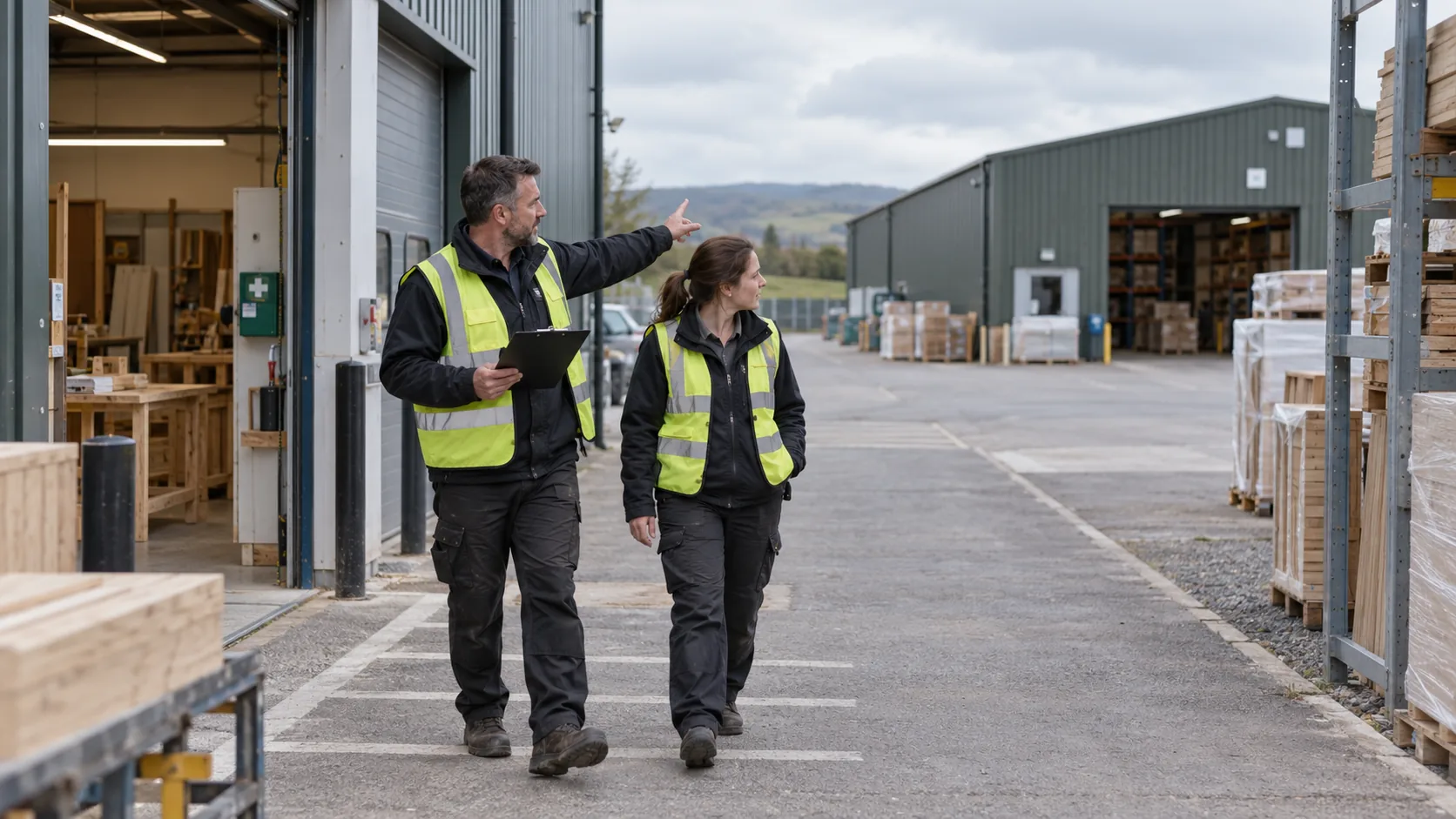
It is not enough to say:
"We have a first-aid kit and a first-aider."
Ask:
Where are they?
Can somebody get to them when they are needed?
Can the first-aider reasonably reach the warehouse?
How will somebody summon help?
Can an ambulance reach the casualty quickly, and does somebody know where to direct it?
Those practical questions are part of determining whether your arrangements are adequate.
Don't forget emergency access
First aid does not end when somebody calls 999 or 112.
Think about what happens next.
Does the caller know the correct address and postcode?
Is there a particular gate or entrance emergency services should use?
Does somebody need to meet the ambulance?
Are there stairs, security doors, access controls or remote areas that could delay responders?
Is mobile reception unreliable?
These details can matter enormously during a real incident and are easy to overlook in an assessment that concentrates only on first-aid certificates and kits.
By this point, you should have a clearer picture of:
what could reasonably happen;
what first-aid response could be needed;
who may need that help;
where incidents could occur;
when the arrangements need to work.
Now turn that into provision.
Come back to the same model:
Situation → Response → Provision
Suppose our furniture business has identified a foreseeable serious machinery-related bleed.
Situation: An employee suffers a severe cut while using production machinery.
Response: Someone needs to recognise life-threatening bleeding, provide appropriate immediate first aid, summon emergency help and manage the situation until further help arrives.
Provision: The employer needs appropriately competent people available when the work is taking place, suitable equipment that can be reached quickly, and an emergency arrangement that gets professional help to the casualty.
Notice what we haven't done.
We haven't started by saying:
"It's manufacturing, so book FAW."
Nor have we said:
"There are 45 employees, so train this many people."
Those may become part of the answer, but the assessment gives us the evidence needed to make those decisions properly.
People and competence
Ask who needs to be available to respond and what they need to know or be able to do.
That may lead to an appointed person, trained first-aiders, additional or specialist competence, or a combination of arrangements depending on what the assessment identifies.
Do not start with the course and work backwards.
Start with the response you need and then decide what competence provides it.
Equipment and facilities
Ask what first-aid equipment is appropriate for the situations you have identified and where it needs to be located.
For our furniture business, that means asking more than:
"Do we own a first-aid kit?"
Instead:
What injuries are we preparing for?
Does the equipment reflect those needs?
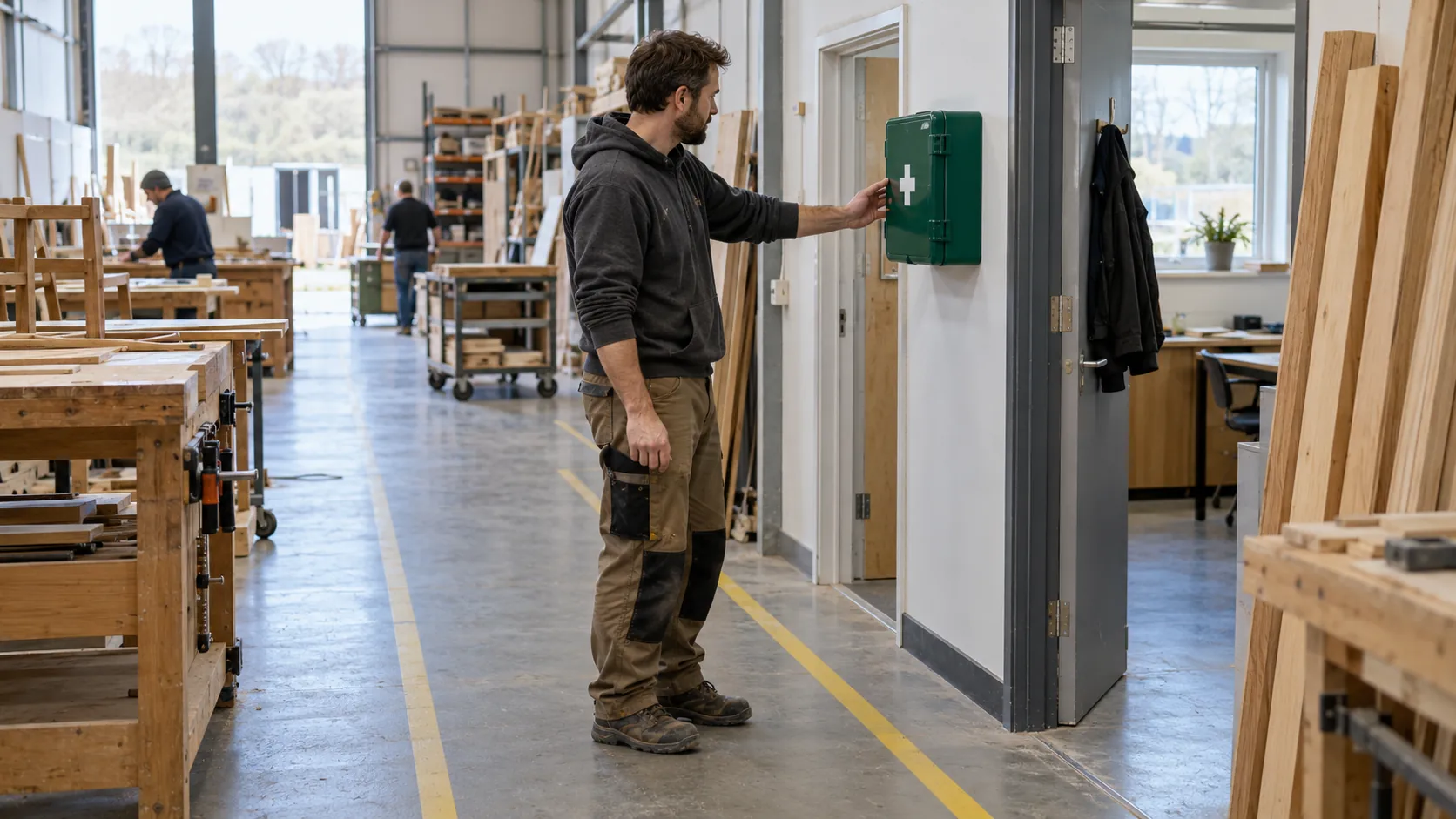
Can people reach it quickly from the production and warehouse areas?
Does any specialist hazard require additional equipment?
Do employees working away from the site need their own provision?
There is no universal first-aid kit list that suits every workplace.
The same needs-based approach applies to facilities such as a first-aid room and to equipment such as an automated external defibrillator (AED).
Do not assume every workplace needs the same equipment.
Equally, don't assume that buying additional equipment solves the problem by itself. Where equipment requires particular knowledge or competence to use appropriately, make sure that forms part of the arrangements too.
Location and emergency access
Provision only works if people can reach it.
Think about where trained people normally work, where equipment is stored, whether different parts of the workplace can obtain help promptly and how emergency services will reach the casualty.
A suitable first-aid arrangement for the office may not automatically provide suitable access for the warehouse or production area.
Two decisions come next
How many people?
Once you know what provision needs to be available, work out how many people you need to train to maintain it across shifts, locations and absences.
How many first aiders do I need in my workplace?
What training?
Once you know the situations people may need to manage, match those needs to appropriate training.
This article owns the assessment. Those guides take the staffing and training decisions further.
An assessment can look perfectly sensible on paper and still fail when applied to a real working week.
Once you have identified the provision you think you need, test it.
For our furniture business, suppose the assessment concludes that appropriately trained first-aid cover needs to be available while production is operating.
Now look at Tuesday at 7am.
Is that cover actually there?
Look at Friday afternoon when one person works from home.
Look at annual leave.
Look at the warehouse.
Look at an employee working alone away from the main building.
The question is no longer:
"Do we employ trained first-aiders?"
It is:
"Is the provision our assessment says we need actually available where and when we need it?"
You do not need a separate formal document called a "first-aid needs assessment" simply because you have carried out this process.
But we recommend keeping a record.
The useful part is not creating another health and safety form.
It is recording why you reached the decision you did.
At the end of the assessment, you should be able to summarise:
Provision required
What people, competence, equipment, facilities and emergency arrangements does the assessment say should be available?
Provision currently available
What do you already have?
Gaps and actions
What is missing or needs to change?
For example:
another person needs training;
existing training needs updating;
equipment needs relocating;
additional equipment is required;
emergency-access information needs improving;
a specialist question needs further advice;
the current arrangements already meet the identified need.
That last outcome matters.
An assessment does not have to produce a training booking or a list of things to buy.
If your existing arrangements meet the needs you have identified, record that conclusion and why.
Do you legally have to write it down?
The first-aid guidance does not require a separate formal or written first-aid needs assessment.
That is different from the wider legal requirements applying to workplace risk assessments, including requirements to record significant findings in certain circumstances.
Don't confuse the two.
Our recommendation is straightforward:
Keep a proportionate record anyway.
For a small, straightforward workplace, that might be brief.
For a complex site with different hazards, shifts, buildings or specialist arrangements, the record will naturally need more detail.
The objective is not paperwork for its own sake.
It is to be able to explain:
"This is what we considered, this is what we decided, and this is why."
When should you review your first-aid needs assessment?
There is no fixed annual legal interval for a first-aid needs assessment.
Official guidance recommends reviewing first-aid needs periodically and particularly when your operation changes.
Review sooner when something material changes, such as:
new machinery or equipment;
a new substance or process;
different activities;
new shifts or working hours;
significant workforce changes;
moving premises;
changes to buildings or access;
different remote or lone-working arrangements;
a first-aider leaving;
substantial changes in public use;
an incident that exposes a gap;
repeated problems maintaining the provision you identified.
Incident and first-aid records can also help you identify patterns that suggest the arrangements need another look.
A stable, straightforward workplace and a rapidly changing manufacturing operation do not necessarily need the same review rhythm.
The important thing is that the assessment remains an accurate description of the workplace you actually have.
What about customers, visitors and members of the public?
The workplace first-aid legislation discussed in this article focuses on employees, but HSE guidance strongly recommends considering non-employees in the needs assessment.
If customers, visitors, pupils or service users regularly use your premises, consider what could reasonably happen to them and whether that changes sensible first-aid arrangements.
Do not simply add visitor numbers to the employee headcount and apply a workplace staffing ratio.
A closed office receiving an occasional visitor and a venue receiving hundreds of people each day may reasonably reach different practical conclusions.
Other legal, contractual, professional or sector-specific duties may also apply in particular settings.
Workplace First Aid Needs Assessment
Work through your activities, foreseeable first-aid situations, people, training, equipment, emergency access and coverage, then record your conclusions and actions.
Download the Workplace First Aid Needs Assessment
The public CTA should only be activated once the final form has been reviewed and its download destination has been verified.
Not ready to complete the full assessment yet?
Use the First Aid Requirements Calculator for an initial indication.
It can help you think through factors such as workplace type, hazards, employee numbers and working arrangements and provide a starting suggestion for first-aid provision and training.
But it cannot inspect your actual risk assessments, machinery, chemical information, workplace layout, emergency access, equipment locations or rota.
Use it to start the process, not to replace the assessment.
THE NORTHLIGHT TAKEAWAY
Situation → Response → Provision
Situation
What could reasonably happen?
Response
What immediate help might be needed?
Provision
What people, competence, equipment and arrangements need to be available?
Then test that provision against the real workplace, record your decision and review it when circumstances change.
The aim is not to complete a form or justify a training course.
It is to make sure that if somebody needs first aid, the arrangements you have made are appropriate for the situation they could reasonably face.
Sources & Further Reading
Northern Ireland legislation: Health and Safety (First-Aid) Regulations (Northern Ireland) 1982, regulations 3 to 4, read with the Health and Safety (First-Aid) (Amendment) Regulations (Northern Ireland) 2017, regulation 2.
Northern Ireland legislation: Management of Health and Safety at Work Regulations (Northern Ireland) 2000, particularly regulation 3, for the separate general workplace risk-assessment duties.
HSENI: First aid at work. Northern Ireland first-aid requirements and use of HSE guidance.
HSENI: First aid. Guidance on assessing needs, appointed persons, equipment and first-aid arrangements.
HSE: First aid at work: Guidance on Regulations (L74), third edition, amended in 2024. Particularly the guidance on assessing first-aid needs, workplace factors, equipment, coverage and review.
HSE: Are you an employer? Guidance on assessing first-aid needs and making appropriate provision.
HSE: First aid in work: Assess your first aid needs. Concise guidance on the factors employers should consider.
HSE: First aid at work: your questions answered (INDG214). Further guidance on workplace first-aid provision.
ICO: Guidance on workers' health information, relevant where identifiable employee health information is handled.
Review sooner if Northern Ireland legislation, HSENI or HSE guidance, relevant Northlight guidance, the First Aid Requirements Calculator or the Workplace First Aid Needs Assessment changes.


RELATED ARTICLES
You might also find these useful
Practical guidance to help you organise training and understand your first aid responsibilities.